

In high-stakes industries, “fit for duty” is not a suggestion. It is a legal and operational necessity. For employers in Vancouver, Surrey, Langley, and across the Lower Mainland, navigating the intersection of WorkSafeBC requirements, privacy laws, and human rights is complex. A robust workplace urinalysis, drug and alcohol testing and monitoring program is the most effective way to manage impairment risk while protecting your team and your reputation.
Canadian Workplace Urinalysis Drug and Alcohol Testing/Monitoring Laws and Rules
In Canada, drug and alcohol testing is not a blanket right. According to the Canadian Human Rights Act, substance dependence is recognized as a disability. This means workplace policies must focus on safety, accommodation, and support rather than punishment.
To be legally defensible, a testing program must be tied to a bona fide occupational requirement (BFOR). This standard has been shaped by decisions from the Supreme Court of Canada and requires employers to demonstrate that testing is reasonably necessary to ensure workplace safety.
In practice, this typically applies to safety-sensitive positions, where impairment could result in direct and significant risk to the employee, coworkers, or the public.
Pre-Employment and Pre-Placement Testing
Pre-employment urinalysis testing is a vital screening tool used after a conditional offer of employment for a safety-sensitive role. This helps ensure that new hires can meet the physical and cognitive demands of the position from day one. In British Columbia, testing may include alcohol biomarkers such as Ethyl Glucuronide (EtG) and Phosphatidylethanol (PEth), which can indicate recent or longer-term alcohol use.
While common in industrial and safety-critical sectors, the Canadian Human Rights Commission advises that pre-employment testing must be part of a broader, non-discriminatory assessment process. A positive result alone is not sufficient grounds to automatically revoke an offer; employers must consider their duty to accommodate under human rights legislation, including whether the individual has a substance use disorder that qualifies as a disability.
Reasonable Cause and Post-Incident Testing
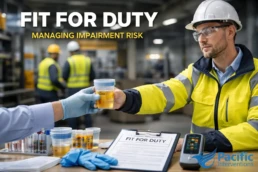
Reasonable cause testing is triggered when a supervisor observes objective, specific, and documented signs of impairment. These may include indicators such as the odour of alcohol, slurred speech, impaired coordination, or unusual behaviour. Proper documentation and, where possible, corroboration by a second trained supervisor are recommended to ensure fairness and consistency.
Under WorkSafeBC regulations, employers have a legal duty to maintain a safe workplace. This includes immediately removing a worker from duty if they are believed to be impaired, in order to prevent potential injury to themselves or others.
Post-incident testing occurs after a significant workplace accident or a “near miss.” However, Canadian legal standards make it clear that an incident alone is not sufficient to justify testing. There must be a reasonable basis to believe that impairment was a contributing factor.
Guidance from the Canadian Human Rights Commission and decisions from the Supreme Court of Canada reinforce that testing must be reasonable, necessary, and proportionate, particularly in safety-sensitive environments.
This underscores the importance of thorough, objective documentation, timely reporting, and appropriate supervisory assessment to ensure the decision to test is legally defensible.
Random Testing and Monitoring
Random testing is a sensitive area in Canadian law. It is generally only permitted in high-risk environments such as oil sands or similar safety-sensitive workplaces, where an employer can demonstrate a documented and ongoing substance use problem at that specific site.
Court decisions from the Supreme Court of Canada and guidance from the Canadian Human Rights Commission confirm that random testing must be justified, proportionate, and connected to workplace safety.
Monitoring and follow-up testing are different. These are typically part of a return-to-work agreement for employees who have completed treatment. These structured plans support long-term recovery while maintaining workplace safety. Tools such as remote breath alcohol monitoring systems may be used to support accountability while respecting privacy.
Chain of Custody and DOT Verification
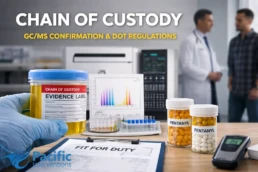
Maintaining a clear and documented chain of custody is essential for any test to be defensible. This process ensures that the sample remains secure and is handled by trained professionals from collection through to final reporting.
If a screening test is non-negative, it must be confirmed using Gas Chromatography or Mass Spectrometry (GC/MS) at a certified laboratory. This confirmation process helps rule out false positives caused by medications or other substances.
For safety-sensitive transportation roles that follow U.S. regulated standards, the Department of Transportation guidelines outline strict testing and verification requirements. As of 2026, testing panels include substances such as fentanyl and norfentanyl. All confirmed positive results must be reviewed by a Medical Review Officer. The Medical Review Officer is a licensed physician who verifies the result and determines whether there is a legitimate medical explanation, such as a valid prescription.
Implementing Your Safety Plan
A well-structured drug and alcohol policy helps reduce workplace risk and supports compliance with Canadian legal standards. Aligning your program with guidance from the Canadian Human Rights Commission and applicable workplace safety regulations helps ensure your approach is both fair and effective.
Clear policies, proper documentation, and consistent procedures create a safer environment for workers and support long-term operational stability.
Contact us today for your free consultationIf you are looking to secure your job sites, explore our specialized workplace drug and alcohol testing and monitoring services. We provide the expert oversight and certified lab results you need to keep your workforce moving safely.
Serving Vancouver, Surrey, Langley, and all surrounding areas of the Lower Mainland.
FAQ's
Generally, no. In BC, random testing is highly restricted and only permitted in extremely dangerous, safety-sensitive environments where the employer can prove an existing substance abuse problem. Most
An MRO is a licensed physician who acts as an independent gatekeeper. They review every lab result to ensure accuracy. If a test is positive, the MRO interviews the employee to determine if a legitimate medical prescription explains the result, protecting both the employer from liability and the employee’s privacy.
In BC, a positive test for a safety-sensitive role allows an employer to pause the hiring process, but it does not allow for “automatic” disqualification. Under human rights law, if an addiction is present, the employer may have a duty to accommodate the individual rather than simply withdrawing the offer.