


How Families End Up Making the Wrong Rehab Decision
Choosing the right rehab center for a loved one struggling with addiction is a major treatment decision. Unfortunately, this decision is often made under time pressure, emotional strain, and with limited clarity about what separates one program from another. Most mistakes do not come from lack of effort. They come from misunderstandings about how treatment matching works in practice. This wrong rehab centre decision guide explains why families commonly choose treatment programs that do not match their loved one’s situation and what questions to ask before making this critical decision.
Why Good Families Sometimes Choose the Wrong Rehab
Families rarely choose the wrong rehab centre because they do not care or fail to try. More often, they are making a difficult decision during a crisis, with limited information and pressure to act quickly.
A common oversight is allowing urgency to replace proper treatment screening. When a loved one finally agrees to seek help, families may worry that waiting will allow the willingness for treatment to disappear. As a result, they may choose the first available program rather than taking time to determine what level of care is required. This can lead to choosing the wrong rehab. A program may appear suitable based on location, availability, or marketing, but it may not provide the medical support or specialized services required for that individual’s situation. When treatment requirements are not properly matched, therapeutic engagement can suffer and the person may even leave treatment early.
Another common misunderstanding is assuming that rehab centers offering similar services provide the same quality of care. Terms such as “individualized treatment,” “holistic recovery,” and “evidence-based therapy” are widely used, but they do not explain how a program is structured or delivered. Differences in clinical staffing, psychiatric support, medical oversight, counselling frequency, family involvement, and aftercare planning can significantly affect treatment quality.
Families should also recognize that not every treatment recommendation is based solely on clinical suitability. Some providers operate in a competitive marketplace where admissions and revenue pressures can influence how services are presented. Marketing may emphasize availability, success claims, or program features rather than whether the treatment facility is a good fit for the individual.
The goal is not simply to find a rehab centre with an available bed. The goal is to find a treatment environment that will address the individual’s personal challenges while providing them with a program they feel comfortable in.
Stop Looking for “The Best Rehab”
A frequent decision error is trying to identify a single “best” facility. This often leads families toward marketing signals instead of clinical fit. A program that works well for early-stage alcohol use disorder may not be suitable for someone with later-stage polysubstance use disorder. This kind of incorrect placement often becomes clear once treatment has already started. Experienced intake professionals and independent placement coordinators generally avoid recommending a universal “best” option. A more clinically useful approach is focusing on appropriate service level rather than searching for a single “best” rehab. This change in framing quickly narrows options to those that match individual requirements.
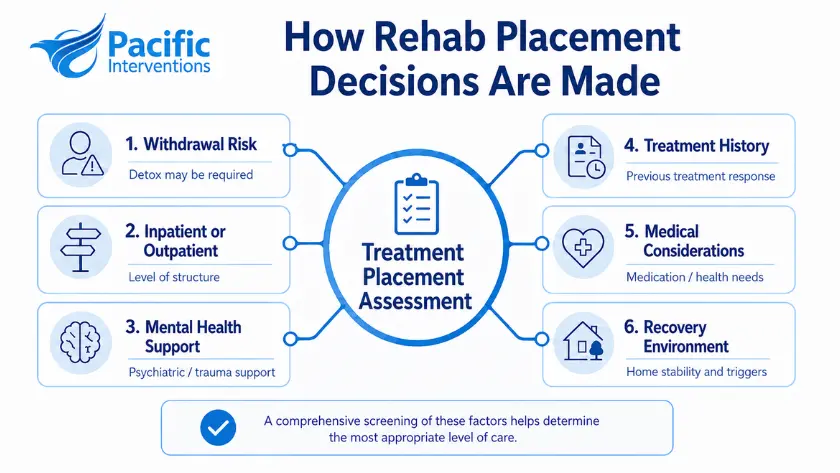
How Rehab Placement Decisions Are Made
One of the first considerations is whether detoxification is required before addiction treatment begins. Detox and rehab are not interchangeable. Someone at risk of serious withdrawal may require medical supervision before they can safely participate in counselling and recovery programming. Placing a person in a non-medical setting when medical support is required can create unnecessary risk and may result in treatment ending before meaningful work can begin.
Another important placement decision is whether inpatient or outpatient treatment is more appropriate. These two approaches provide very different levels of structure and support. Inpatient treatment requires the person to live at the facility while receiving daily programming, supervision, and a structured recovery environment away from outside triggers. Outpatient treatment allows the person to continue living at home while attending scheduled addiction counselling appointments. The decision often comes down to whether someone can safely and consistently engage in treatment while maintaining their current living situation.
Co-occurring mental health conditions, including trauma-related symptoms, depression, anxiety disorders, and psychiatric instability, can influence the level of support someone requires during treatment. A person who requires additional psychiatric support or trauma-informed care may struggle to stabilize in a setting that does not address these concerns.
Previous treatment history is also reviewed because repeated treatment attempts can reveal barriers that were not addressed in earlier programs. Therefore, someone entering treatment for the first time is assessed differently from someone who has completed multiple programs. A thorough screening process examines what approaches were previously attempted, what barriers affected progress, and whether a different treatment structure or level of support may be more appropriate.
Medical conditions, medication requirements, and the person’s recovery environment are also considered when determining placement. Some individuals require a program with greater medical oversight, while others may need distance from an environment that increases the likelihood of returning to substance use.
Clinical Insight: When Treatment Structure Needs to Adapt
While working as an addiction counsellor in a residential treatment facility, I noticed a participant consistently disengaged during group education sessions. The clinical schedule was heavily structured around psychoeducation groups, about 4 to 5 hours per day and roughly 20 hours per week. The client struggled with the format and was at risk of leaving treatment early. Instead of increasing pressure to follow the standard schedule, an alternative approach was introduced. Once per week, a less formal therapeutic conversation was introduced outside the traditional group environment. The setting involved playing golf. The aim was to reduce resistance and cognitive fatigue while maintaining therapeutic engagement through a different format. Over time, engagement improved and became more consistent.
The key takeaway is that structure sometimes needs flexibility to maintain engagement, especially when standard formats reduce participation. Adjusting therapeutic delivery can preserve effectiveness without lowering standards.
Four Warning Signs You’re Choosing the Wrong Rehab
One common error is accepting a recommendation before the full picture is understood. If placement is suggested after minimal questioning, important factors like psychiatric history or withdrawal severity may not have been considered. This increases the risk of a poor match.
Another warning sign is focusing on comfort and surroundings while overlooking key factors such as the level of care, staff qualifications, treatment approach, and ability to manage the person’s specific risks. Families often read confidence and friendliness as competence. Without clear discussion of risk and reasoning behind the recommendation, the decision is not fully grounded in the participant’s best interests.
A third warning sign is vague or generic recommendations. If a provider cannot clearly explain why one level of care is recommended over another, decisions may be based on availability rather than fit. This increases the risk of treatment failure.
A fourth issue is when a program is described as suitable for most people. Addiction severity varies widely, and treatment requirements are not uniform. Programs that do not differentiate between client types often under-serve higher-complexity cases.
Clinical Insight: When Social Pressure in Treatment Becomes Overwhelming
A common situation that can lead someone to struggle in a treatment setting, even when they are ready for admission, is entering a large group-based program after a long period of isolation. In these cases, the individual may be medically and psychologically stable enough for admission but have limited social coping strategies. The intensity of group interaction and constant interpersonal exposure can create internal pressure during early recovery.
This pressure can increase the urge to seek relief. In early recovery, that response is often closely linked to substance use patterns, which can increase the risk of disengagement if not supported. The issue is not willingness to participate. It is additional levels of discomfort created by the individual’s social regulation capacity and the demands of a high population treatment environment during early stabilization.
It is important to note that this situation is not always going to lead to treatment disengagement or relapse, but during the screening phase it is an important aspect to consider.
Questions That Reveal Whether a Rehab Is the Right Fit
Most families ask general facility questions about comfort, approach, or philosophy. These can be helpful, but they do not always reveal whether a program can handle the person’s actual needs in practice.
A more useful starting point is asking the intake screener to explain why a specific level of care is being recommended for this person. The answer should clearly connect to withdrawal risk, mental health stability, and treatment history. If it does not, the recommendation may not be fully individualized.
It is also useful to ask what specific changes in the person’s situation would lead to a different recommendation. For example, if medical risk increases, if mental health symptoms worsen, or if recent substance use patterns change. This helps show whether the decision is based on real screening factors or general availability.
Families can also ask directly about how mental health concerns are handled alongside addiction treatment. Some programs have onsite psychiatric support, while others rely on external referrals. This difference can affect stability during early treatment.
Another practical question is how family involvement is handled during treatment and after discharge. Some programs include structured family sessions, while others keep it limited or optional. This can influence long-term outcomes.
Finally, it is important to ask what aftercare planning actually looks like before admission. Clear discharge planning should be in place early, not added at the end of treatment.
Choosing a Rehab Starts With Proper Screening
As discussed in this blog, most placement mismatches start earlier in the treatment selection process. They begin during the screening process carried out by intake screening professionals when important clinical and practical information is not fully explored.
Proper screening identifies the key constraints that shape an effective treatment placement. Only after individual factors are understood does it become possible to meaningfully compare treatment options. Without a thorough assessment process, families are often left comparing programs based on appearance, availability, or marketing rather than suitability. In those cases, decisions shift toward presentation, messaging, or marketing rather than best rehab placement.
When screening is done effectively, the number of suitable options usually becomes smaller. This improves accuracy by eliminating programs that do not match the individual’s personal requirements.
Need Help Choosing the Right Rehab?
Need help choosing the right rehab center? Pacific Interventions can help you clarify the most appropriate level of care for your situation.
Contact us via email or call 1-604-537-3503 to discuss your options in a free consultation.
Clinical Review Statement
Clinically reviewed by Jeffrey Norell, Addiction Specialist. This article has been reviewed for clinical accuracy and reflects current evidence-based principles and accepted practices in addiction rehab screening, treatment planning, and rehabilitation.Top of Form
Frequently Asked Questions
Is it okay to contact more than one rehab before making a decision?
Yes. Speaking with more than one treatment provider or independent third-party admissions coordinator can help you compare recommendations and understand why one program may be a better fit than another. If the recommendations are very different, ask each person to explain the reasons behind them so you can make a more informed decision.
What if my family member refuses the rehab that seems like the best fit?
This can happen, especially if the recommended program feels unfamiliar or uncomfortable. Instead of immediately choosing a different facility, try to understand why they are refusing. Sometimes the concern can be addressed without changing the treatment recommendation. A decision made only to gain agreement may not lead to better long-term outcomes.
Should I choose a rehab close to home or farther away?
There is no single right answer. Staying close to home may make family involvement and aftercare easier. Going farther away may reduce exposure to people, places, or situations that contribute to substance use. The best choice depends on the person’s circumstances rather than distance alone.
Does a more expensive rehab usually provide better treatment?
Not necessarily. Cost does not always reflect the quality of care or whether a program is the right fit. The most important question is whether the facility can safely support the person and provide the level of care they require.
What should I have ready before speaking with an intake screening professional?
It helps to have a basic understanding of the person’s substance use, previous treatment history, current medications, medical conditions, mental health concerns, and any immediate safety issues. Having this information available can make the screening process more accurate and help identify the most appropriate treatment options.