

Introduction
Drug rehab cost in British Columbia depend on whether care is publicly funded or privately paid, and the level of medical and clinical support required. Costs are not fixed because treatment is built around individual clinical needs, staffing intensity, and program structure.
This guide breaks down how the system works, what treatment typically costs, and how different levels of care affect pricing.
Public vs Private Drug Rehab in British Columbia
British Columbia uses two parallel systems for addiction treatment.
Publicly Funded Care
Public programs are delivered through the provincial health system and community services. They may be free for eligible residents, depending on assessment and availability. Access is limited by program capacity and wait times.
Private Treatment
Private programs are accessed directly through providers. Admission usually involves an intake screening to determine clinical needs. Costs are paid privately or through extended healthcare insurance plans. Private care generally provides faster access and higher staffing intensity compared to public services.
Average Drug Rehab Costs in British Columbia (2026)
- Public programs – Free or subsidized per admission
• Private medical detox – $500 to $1,200 per day
• Outpatient treatment – $5,000 to $10,000 per month
• Residential rehab – $5,000 to $20,000 per month
• Luxury residential programs – $25,000 to $60,000+ per month
Public care is not priced per service. Private costs vary based on staff qualifications, facility accommodations, and clinical appraoch.
Clinical Insight: Access Gaps in Public Care
Government funded rehab services often involve waiting periods between assessment and admission. During this time, some individuals disengage from the process or lose motivation to continue with treatment. Maintaining support at a program like The CORE (Community Outpatient Recovery Experience) during the waiting period can help people preserve their recovery motivation.
How Access to Treatment Works in BC
Public Access
Usually involves referral through a physician, hospital, or community intake service, such as Central Addiction Intake Team (CAIT). Placement depends on clinical need and program availability.
Private Access
Involves direct contact with a treatment provider followed by intake screening to determine appropriate level of care and admission timing.
What Determines Private Drug Rehab Cost
Cost is driven by clinical appraoch rather than program length.
Higher costs usually reflect:
- higher staff-to-client ratios
- in-house addiction doctor
- 24-hour a day nursing
- psychological and psychiatric staff
- number of one-on-one therapy sessions
- private room accommodations
- specialized food services
Medical Detox Cost in British Columbia
Detox is a short medical stabilization phase before treatment begins. It is not a complete rehabilitation program. There are both public and private detox options.
Public Outpatient Detox (RRAC)
Outpatient detox is commonly delivered through Rapid Access to Addiction Care (RRAC) clinics and similar community programs. It typically includes medical assessment, withdrawal management support, and medication guidance while the person remains living at home.
Typical cost:
• Free (publicly funded services)
Used when:
• withdrawal risk is low to moderate
• stable housing is available
• 24-hour monitoring is not required
Public Inpatient Medical Detox
Public inpatient detox facilities are operated by regional health authorities for higher-risk withdrawal cases requiring 24-hour medical supervision.
It includes nursing care, monitoring, and medication support during the acute withdrawal phase.
Typical cost:
• Public: free or subsidized
Used when:
• withdrawal risk is moderate to severe
• medical complications are possible
• home-based detox is not safe
Private Inpatient Detox
Some private inpatient treatment facilities will utilize public detox programs, while others will utilize their own independent services. If the treatment program coordinates its own detox services, they will employ their own in-house doctors and nursing staff.
Typical cost:
• Private Detox: $500 to $1,200 per day
Higher-level private care may include:
• addiction physicians on site
• 24 hour nursing support during withdrawal.
Private Outpatient Rehab vs Private Residential Treatment
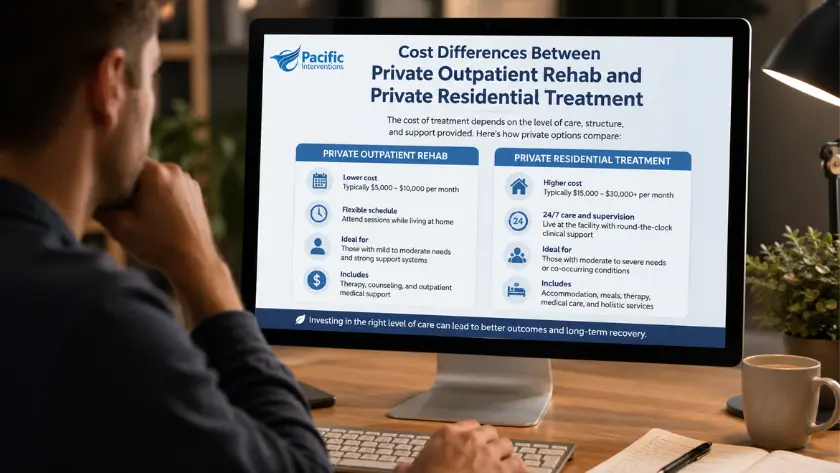
Outpatient Addiction Rehab
Outpatient treatment program participants live at home and attend scheduled addiction counselling sessions.
Typical cost: $5,000 to $10,000 per month
Includes:
- addiction counselling and psychological therapy
- one-on-one sessions
- treatment planning
- relapse prevention support
- recreation combined with therapy
- life-skills development
- aftercare planning
Best suited for stable living situations and lower or no medical withdrawal risk.
Residential Addiction Treatment
Residential treatment program participants live at the alcohol and drug addiction treatment facility with 24-hour support.
Typical cost: $5,000 to $20,000 per month
Includes:
- accommodation and meals
- withdrawal management
- 24 hour supervision
- structured addiction therapy
- peer support
- clinical monitoring
- discharge support
- sober living
The key difference is continuous supervision and controlled environment.
Rehab Insurance Coverage in British Columbia
Coverage varies significantly by plan. Always check with your insurance provider to find out what is and isn’t covered.
Some policies may include:
- may provide outpatient counselling, but not outpatient addiction treatment
- insurance plans may have full, partial or no residential coverage
- policies could pay via direct billing, or by reimbursement
- annual or lifetime limits on psychological health services
Most alcohol and drug addiction rehab programs require coverage verification from the insurance provider before admission.
Key Takeaways
- Cost is mainly driven by clinical intensity and level of support
• Public treatment is lower cost but depends on availability and wait times
• Private treatment allows faster access and more choice in program type
• Best outcomes come from matching care level to clinical need, not price
Need Help Choosing a Rehab Program?
With so many treatment options available, finding the right program isn’t always straightforward. Speaking with an experienced addiction professional at Pacific Interventions can help clarify the differences and what may be appropriate for your situation.
Contact Pacific Interventions for a free, confidential consultation.
Frequently Asked Questions:
Can I work or attend school while receiving treatment?
It depends on the level of care that is best suited to the individual’s situation. Residential treatment requires you to live at the facility, so it usually requires taking time away from work or school to focus on recovery. Outpatient rehabilitation programs are designed to provide greater flexibility, allowing individuals to continue working or studying while attending scheduled treatment sessions.
What happens while waiting for public treatment?
After assessment, there can be delays before admission depending on local capacity. During this time, people often remain in the community and continue using support services or informal care while waiting for placement.
Can someone go straight into residential rehab in BC?
Usually not through the public system. Many cases involve a step through assessment, stabilization, or detox first. Private programs may allow direct entry if medical screening confirms it is safe.
What determines where someone receives treatment?
For publicly funded treatment, placement is based on clinical need and program availability. Individuals are generally offered the first appropriate program that becomes available rather than being able to choose a specific facility. Private rehab offers greater flexibility, allowing individuals to choose a program that best fits their preferences, location, accommodations, and amenities.
What happens after rehab ends?
One of the most challenging periods is after treatment ends. Maintaining momentum is an important part of long-term recovery, which is why aftercare planning is a critical component of rehabilitation. Effective aftercare planning helps individuals prepare for the challenges they may face after leaving treatment. Some people may require sober housing to provide a stable and substance-free living environment, while others may benefit from employment assistance, educational support, ongoing counselling, or community recovery services.
Sources:
- British Columbia Ministry of Health – Mental Health and Addictions
- BC Centre on Substance Use (BCCSU)
- BC Road to Recovery Program
- BC PharmaCare guidance
- Accreditation Canada standards
- CARF International framework
Clinical Review
Jeffery Norell (Read bio here)
Addiction Specialist
Addiction Medicine Diploma, BC Centre on Substance Use (BCCSU)